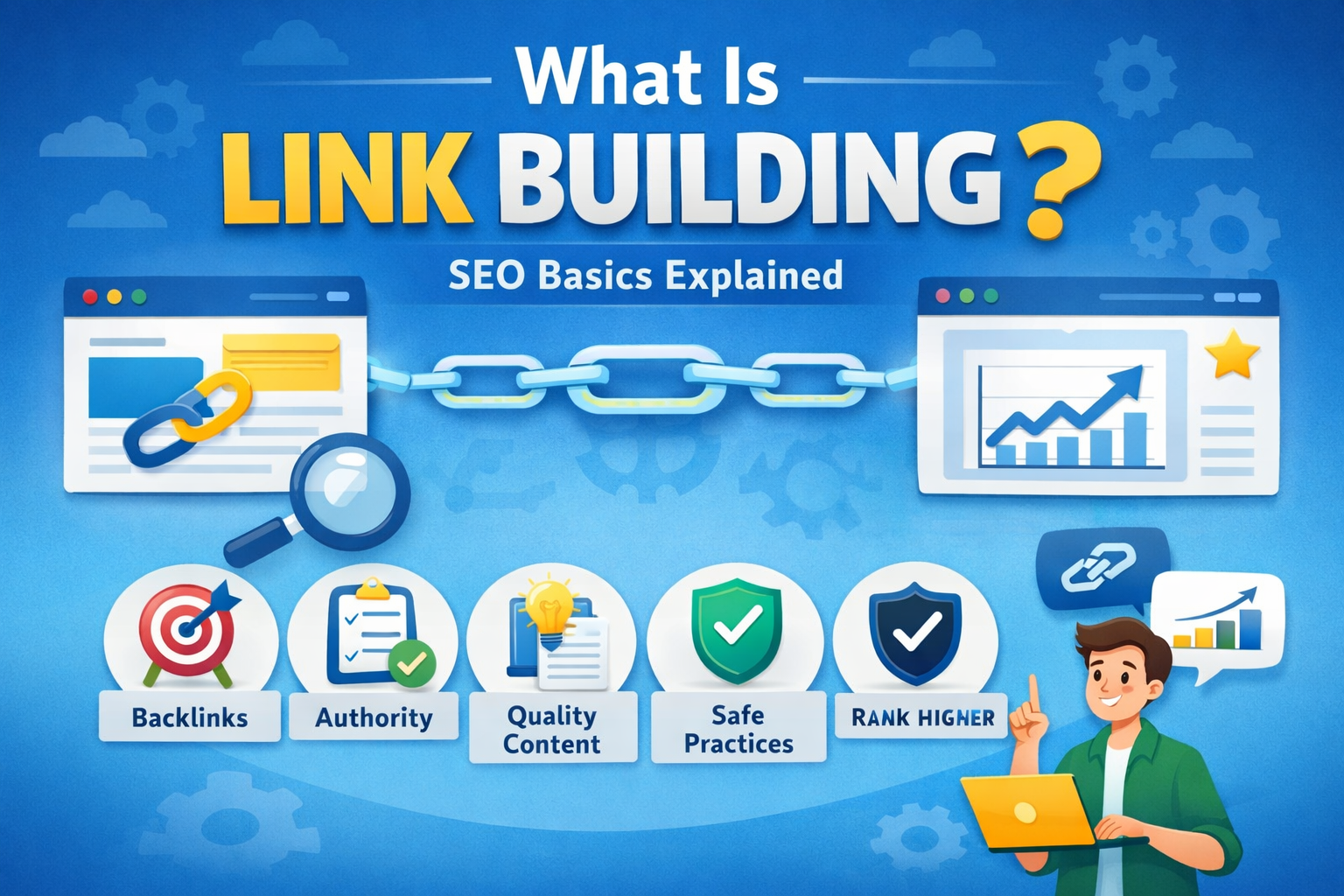
When people talk about SEO, they usually think about keywords, content, and technical optimization. But there’s another key piece of the puzzle that often gets misunderstood – link building.
In simple terms, links help search engines understand which websites can be trusted. When one site links to another, it’s like a recommendation. The more relevant and trustworthy those recommendations are, the stronger the signal for Google.
That doesn’t mean every link is good or that more links always equal better rankings. One high-quality backlink from a relevant website can be more valuable than dozens of random or low-quality ones.
Even today, link building remains one of the core ranking factors in SEO. The rules have changed, the approach has matured, but links still play a major role in how websites compete in search results.
What is link building?
Link building is the process of getting other websites to link to your website. These links are also called backlinks.
From a search engine’s point of view, a backlink is a signal. It shows that another website considers your content useful, trustworthy, or worth mentioning. The more relevant and authoritative the linking website is, the stronger that signal becomes.
For example, if a well-known SEO blog links to your article about keyword research, Google sees this as a positive sign. It suggests that your content is valuable within that topic.
It’s important to understand that link building is not about collecting as many links as possible. The goal is to earn links from websites that are relevant to your niche and trusted by both users and search engines.
In short, link building helps search engines evaluate the credibility of your website and decide how high it should appear in search results.
How links work in SEO
Search engines use links to discover new pages and to understand how websites are connected to each other. When a page receives links from other sites, it sends a signal that the content is worth crawling, indexing, and ranking.
However, not all links have the same impact. Search engines look at several factors to evaluate link value.
First, authority matters. Links from well-established, trusted websites usually carry more weight than links from small or unknown sites. A single backlink from a strong domain can influence rankings more than many weak ones.
Second, relevance plays a big role. A link from a website that operates in the same or a closely related niche is much more valuable than a link from an unrelated source.
Third, context is important. Links placed naturally within the main content of a page tend to perform better than links hidden in footers, sidebars, or comment sections.
Because of this, link building is not just about getting links, but about building meaningful connections between relevant pages across the web.
Types of links
In SEO, links can be divided into several main types. Understanding these differences helps you build a healthier and more effective link profile.
- Internal links
Internal links connect pages within the same website. They help users navigate your site and allow search engines to understand your site structure, hierarchy, and page priorities. - External links
External links point from one website to another. When another site links to yours, this is called a backlink, and it plays a key role in link building and rankings.
Links can also be categorized based on how search engines treat them.
- Dofollow links
Dofollow links pass authority from one page to another. These links directly influence rankings and are usually the main goal of most link building strategies. - Nofollow links
Nofollow links include a special attribute that tells search engines not to pass ranking authority. While they may not directly affect rankings, they can still drive traffic and help create a natural-looking link profile.
Another important distinction is how links are obtained.
- Natural links
Natural links are earned organically when other websites link to your content without being asked. These are often the strongest and safest type of backlinks. - Built links
Built links are the result of active link building efforts such as outreach, guest posting, partnerships, or PR campaigns.
A balanced mix of different link types is a strong signal of a natural and trustworthy website.
What makes a good backlink
Not every backlink brings value to your website. Some links can significantly improve your SEO, while others may have little or no impact.
One of the most important factors is the authority of the website linking to you. Links from trusted, well-established domains usually carry more weight than links from low-quality or spammy sites.
Relevance is just as important. A backlink from a website in the same industry or niche sends a much stronger signal to search engines than a link from an unrelated topic.
The anchor text also matters. It helps search engines understand what the linked page is about. Natural, descriptive anchors work better than over-optimized or repetitive keyword-based ones.
Link placement plays a role as well. Links placed inside the main content of a page are usually more valuable than links in footers, sidebars, or author bios.
Finally, a good backlink often has real traffic potential. If users actually click the link and visit your site, it’s a sign that the link is useful, not just created for SEO.
In short, a good backlink looks natural, comes from a relevant and trusted source, and provides value beyond rankings alone.
Popular link building methods
Link building includes different approaches, and each of them works best in specific situations. Below are the most common link building methods, explained in more detail.
- Guest posting
This method involves publishing articles on relevant websites within your niche and placing a link back to your site. Guest posting works best when the website has real traffic, editorial control, and an audience interested in the topic. Low-quality guest posts created only for links tend to lose value over time, so relevance and content quality are essential. - Niche edits
Niche edits are links added to existing articles that are already published and indexed. Because these pages often have authority and history, niche edits can be very effective. The main requirement is natural placement – the link should fit the context and provide value to readers. - Linkable assets
This approach focuses on creating content that naturally attracts backlinks. Examples include detailed guides, original research, statistics, templates, or useful tools. Linkable assets usually require more effort but can generate links over a long period without constant outreach. - Business directories and citations
Directories and listings help create a basic link foundation, especially for new websites and local businesses. While these links usually don’t have strong ranking power, they improve trust signals, brand visibility, and profile diversity. - PR and brand mentions
PR-based link building aims to earn links through mentions in articles, news, or industry publications. Links from authoritative media sources can significantly strengthen a website’s credibility. Even unlinked brand mentions can still support overall SEO visibility. - Forum links (community mentions)
Forum links can be useful when they come from real discussions in relevant communities (e.g., niche forums, Q&A platforms). They rarely pass strong SEO value (many are nofollow), but they can drive targeted referral traffic, build credibility, and sometimes lead to natural mentions on other sites. The key is to contribute genuinely and avoid automated posting or repeated keyword anchors.
Using a combination of these methods helps create a more natural and sustainable link profile over time.
When forum links help vs when they hurt
Forum links can be useful in SEO, but only in the right context. Their impact depends on how and why they are used.
Forum links help when:
- They are placed in relevant niche communities or industry forums.
- The account has real activity and posting history, not just promotional links.
- The link appears naturally within a helpful answer or discussion.
- Anchor texts are branded or natural, not keyword-heavy.
- The link drives real referral traffic and user engagement.
Forum links hurt when:
- Links are posted only to promote a website without adding value.
- The same link or anchor text is repeated across multiple threads.
- Automation or mass posting tools are used.
- Links come from unrelated or low-quality forums.
- Profiles are created solely for link placement and then abandoned.
Forum links should be treated as a supporting tactic, not a core link building strategy. When used correctly, they can bring targeted traffic and help with brand visibility, but misuse often leads to spam signals rather than SEO benefits.
White hat vs black hat link building
| Criteria | White hat link building | Black hat link building |
| Approach | Follows search engine guidelines | Uses manipulative tactics |
| Main focus | Quality, relevance, long-term value | Speed and short-term results |
| Typical methods | Guest posts, PR, linkable content, outreach | Link farms, PBNs, automated links, bulk link buying |
| Risk level | Low | High |
| Impact on rankings | Stable and sustainable growth | Temporary gains followed by drops |
| Penalty risk | Minimal | High risk of manual or algorithmic penalties |
| Long-term value | Builds trust and authority | Damages site reputation |
| SEO strategy fit | Suitable for serious, long-term projects | Often used for short-term or risky projects |
White hat link building requires more time and effort, but it supports stable growth and protects your website from penalties. Black hat methods may look attractive at first, but they often lead to ranking losses and costly recovery work.
Common link building mistakes
Many beginners make the same mistakes when starting with link building. These errors can slow down growth or even harm a website’s SEO.
- Buying cheap links in bulk
Low-cost link packages often come from spammy websites or link networks. These links usually provide little value and increase the risk of penalties. - Over-optimized anchor texts
Using the same keyword-rich anchor text again and again looks unnatural. A healthy link profile includes branded, generic, and natural anchors. - Focusing on quantity instead of quality
Getting many low-quality links is far less effective than earning a few strong, relevant backlinks from trusted websites. - Ignoring relevance
Links from unrelated niches send weak or confusing signals to search engines. Relevance is one of the most important factors in link value. - Building links without strong content
Links work best when they point to useful, well-structured content. Without quality content, even good links may have limited impact. - No clear strategy
Random link building without goals, priorities, or tracking often leads to inconsistent results and wasted effort. - Treating forums as a link dump
Posting links without adding value can trigger moderation, damage brand trust, and create a spammy link footprint.
Avoiding these mistakes helps build a cleaner, safer, and more effective backlink profile over time.
Is link building still relevant?
Link building is still an essential part of SEO, but the rules have changed significantly over time. What worked years ago no longer delivers the same results today.
- Search engines still rely on links
Backlinks remain one of the strongest signals for measuring website authority and trust. They help search engines understand which pages deserve higher visibility in search results. - The focus has shifted from quantity to quality
Modern algorithms prioritize link relevance, authority, and natural placement. A small number of strong backlinks can outperform a large volume of weak or artificial ones. - Relevance and context matter more than ever
Links work best when they come from websites and content closely related to your topic. Contextual links inside meaningful content send clearer signals than isolated or unrelated mentions. - User behavior strengthens link value
Links that attract real users, clicks, and engagement are more valuable than links created only to influence rankings. Search engines increasingly evaluate how users interact with linked content. - Link building is part of a bigger SEO strategy
Backlinks are most effective when combined with strong content, solid technical SEO, and good internal linking. On their own, links are not a magic solution.
Link building is no longer about finding shortcuts. It’s about building credibility, authority, and long-term trust – both for search engines and real users.
Conclusion
Link building is not a shortcut or a one-time task. It is a long-term process that helps search engines understand the trustworthiness and relevance of your website.
High-quality backlinks, earned from relevant and authoritative sources, can significantly strengthen your SEO performance. At the same time, low-quality or manipulative links can do more harm than good.
The most effective link building strategies focus on value – useful content, natural mentions, and real connections within your niche. When links are built with users in mind, they support stable rankings and sustainable growth.
For beginners, the key is to start simple: understand how links work, avoid risky tactics, and build links as part of a broader SEO strategy. Over time, this approach delivers far better results than chasing quick wins.